What Changes at a Home Care Agency Once Caregivers Have Benefits
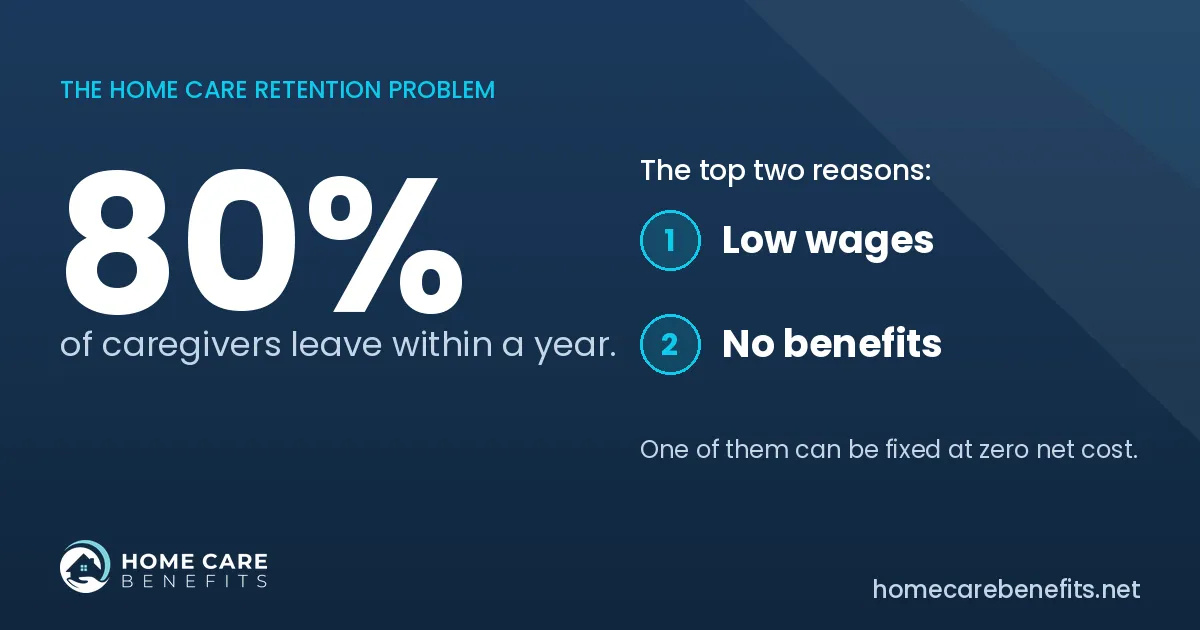
Seventy-five percent. That is the median caregiver turnover rate in the most recent home care benchmarking report, and at a forty-caregiver agency it means rebuilding the roster about thirty times a year, nearly all of it through the owner's own calendar. Benefits do not erase that work. They change who leaves, and that changes what Monday looks like.
Open your calendar and scroll back ninety days. Count the interviews. Now count how many of those people are still on the schedule this week. At most agencies the second number is a fraction of the first, and the gap between them is where a year of the owner's own working hours quietly went.
None of that calendar shows up on the P&L. Recruiting hours are not a line item. They come out of the hours that would otherwise go to referral sources, to intake calls, and to the two or three families who called last month and never heard back.
This is nobody's mistake. At median turnover a roster has to be rebuilt every year, and interviewing is the one lever an owner can pull without new money. So the owner interviews.
Where do the hours go when they come back?
To whatever you were not doing. For most owners that is the inquiry pile. Activated Insights' 2026 home care benchmarking report found that agencies tracking every client inquiry reported median revenue of $3.15 million against $1.40 million for agencies that do not, and that gap has widened for five straight years.
Four things in an owner's week answer differently once caregivers have something to point at, on top of the recruiting arithmetic already running.
| The question | When nobody has benefits | When they do |
|---|---|---|
| "So what do you offer?" | A wage range, and then a change of subject | A wage range and a benefit she can use this week |
| Whose shift she picks up | Whoever called her first | One more reason to pick yours |
| Where your recruiting hours go | Rebuilding the roster | Intake calls and referral sources |
| What it costs the agency | Nothing, and it shows | Employer payroll tax you already pay |
Most of my caregivers are part-time. Does this apply?
Yes. The thirty-hour line you are thinking of is a group carrier's underwriting rule, not tax law. A Section 125 election is open to W-2 employees regardless of how many hours they work, which matters in an industry where nearly half of home care workers are part-time by PHI's count. The options for part-time caregivers are narrower, not absent.
I priced benefits once and closed the spreadsheet
Because you priced the two that need new money. A raise and a group plan. Two dollars an hour on a thirty-hour caregiver runs $3,120 a year, $3,359 once the 7.65 percent employer FICA goes on top, and $134,360 across forty people, which at a seven to ten percent net margin is the margin. A Section 125 wellness plan funds from a different place: the employer payroll tax already leaving the business every pay period gets redirected into benefits instead.
On whether that is allowed, the structure dates to 1978 and the designs regulators objected to were specific double-dipping arrangements. CBIZ wrote the CPA opinion and HitesmanLaw the legal assurance, both posted on the compliance page. Each objection is answered on the page about whether these plans are legitimate.
What this does not change
It is not insurance. No hospital network, no deductible, no major medical. If a caregiver needs surgery, the plan does not pay for it, and an owner who lets an applicant believe otherwise will be found out inside a month. The second limit is quieter: a caregiver has to activate her dashboard and keep a monthly wellness activity going, so an agency that emails out a login and moves on ends up with a plan nobody opens.
Those benefits are UnifyWell's published plan terms: generic medications and 24/7 virtual care and counseling at no cost, dental up to 60 percent off.
What would this look like at your agency?
Two inputs answer it. How many caregivers you have, and roughly what they earn. That is the whole ask and it stays small on purpose, because nobody is going to ask you for a document at any point in the process.
The estimator takes those two numbers and shows what your agency currently pays in employer payroll tax, what turnover at the industry median is costing you, and what could be redirected into caregiver benefits instead. Thirty seconds, no signup. UnifyWell's published example nets an employer roughly $640 per participating employee per year on a $44,000 earner, after the monthly administration fee, and across Home Care Benefits' own proposals the figure has landed between $300 and $900. That is a range, not a quote. Only your own numbers show which caregivers qualify and what lands on their check. Have your CPA read the plan documents first.
See what your own payroll tax would fund
Two inputs and thirty seconds. It shows what your agency pays in employer payroll tax now, and what that same money could fund for your caregivers instead.
Open the estimatorFree, no signup, and no documents to send.
Home Care Benefits is not an insurance company and does not sell insurance. A Section 125 wellness plan is not a substitute for major medical coverage. Benefit descriptions reflect UnifyWell's published plan terms and are subject to change. Savings figures are estimates, not guarantees, and depend on wages, participation and plan design. Nothing here is tax or legal advice. Have your own CPA and benefits counsel review the plan documents before adopting a plan.